
Product Launch Marketing: From Day One to Traction
A great product can spend months in development and still disappear within days of going live. That usually has very little to do with the product itself. More often, the difference comes down to the product launch marketing strategy behind it. Customers pay attention because someone created enough curiosity and enough reasons to care well ahead of the launch.
And that is exactly what we are going to help you build – a complete product launch marketing plan, from shaping your launch before anyone knows your product exists to turning early interest into steady traction.
What Is a Product Launch Marketing Strategy?
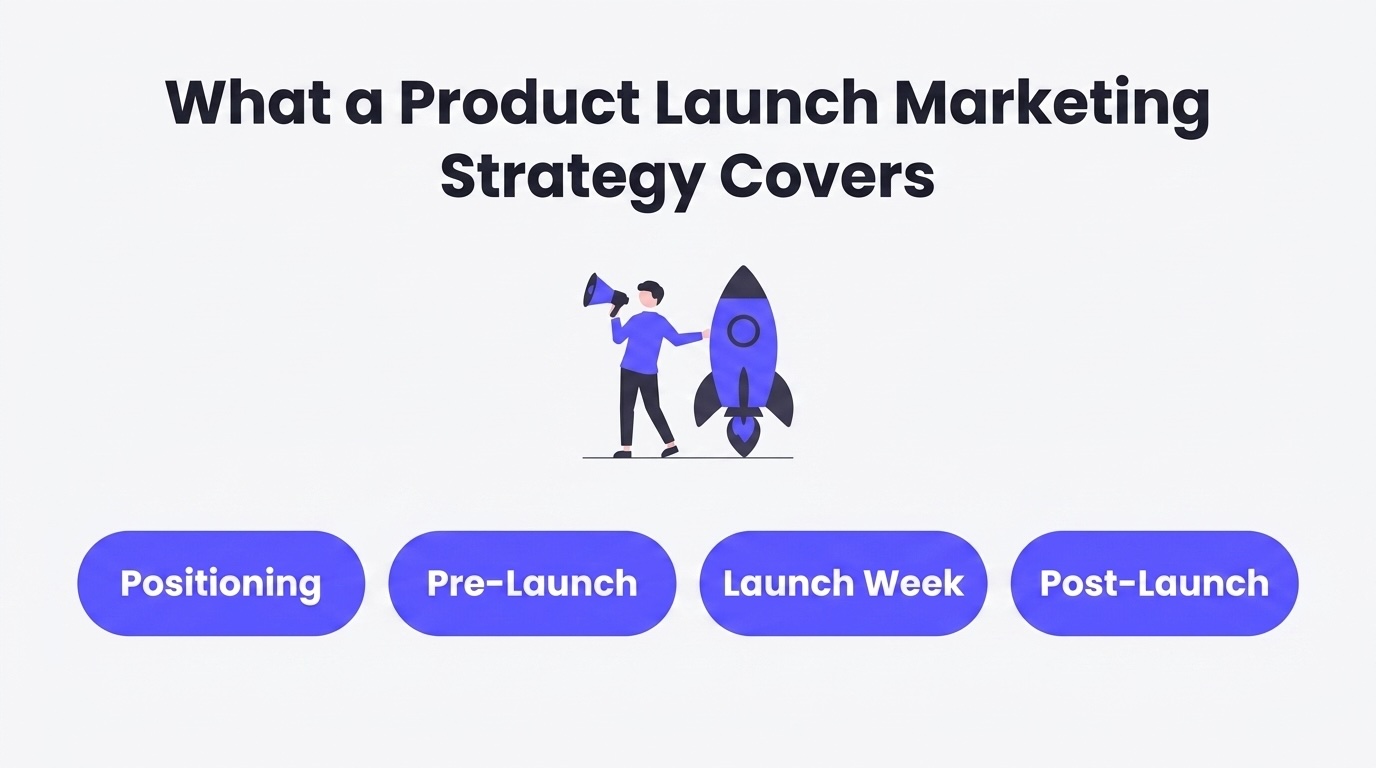
A product launch marketing strategy is a comprehensive plan covering the full sequence of marketing moves from the moment you decide to launch through the months after your product goes live.
It is not just launch day. It starts with positioning and conducting market research – getting clear on who you are selling to and why they would pick you over what they already use. Then comes pre-launch, where you build an audience and generate awareness before the product exists publicly.
Launch week is the concentrated push. Post-launch is where you either build traction or watch signups stall. Most founders put all their energy into the push and ignore everything after it. That is why most launches get forgotten.
Pre-Launch Product Marketing Strategy: How to Build Demand Before You Ship
What you do in the 8-12 weeks before launch day matters more than launch day itself. MIT Professional Education notes that up to 95% of new products fail, citing the work of Clayton Christensen, emphasizing that many failures stem from a lack of genuine market need.
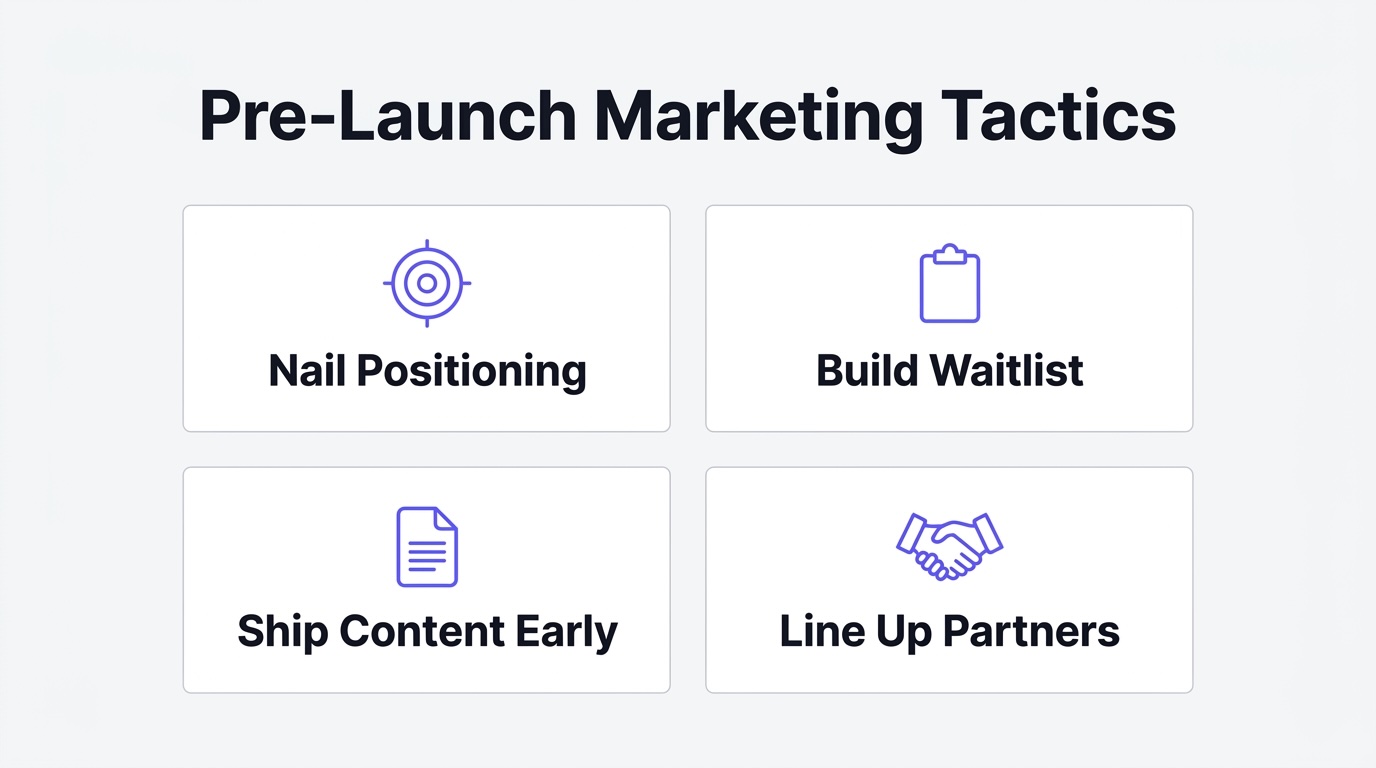
1. Nail Your Positioning Before You Write a Single Ad
If you skip this step, everything downstream will be directionless. Positioning is the decision about who specifically this product is for and what it directly replaces in their current workflow.
- Write a one-sentence compelling value proposition: "[Product] helps [specific person] do [specific outcome] instead of [what they currently use]." Share it with 5 people outside your sales team and see if they get it within 10 seconds.
- Name the 2-3 products your buyer currently uses to solve this problem. Your launch messaging has to explain why switching makes sense… against those specific alternatives, not against "the market."
- Sit down with 10 potential customers and note the words and phrases that come up again and again. Copy those into your ads and landing page. Their words will always outperform yours.
2. Build a Waitlist That Actually Converts
Most waitlist pages say "coming soon" and collect an email. That is it. Then the founder wonders why only 4% of the list signed up on launch day. A waitlist works when it gives people a reason to care before the product exists.
- Offer something real in exchange for the email. Early access paired with a founding-member discount converts far better than a blank signup form. A free resource tied to the product's use case works too.
- Add a referral mechanic with Viral Loops or SparkLoop. Subscribers who share a link move up in line. This turns every signup into a potential customer acquisition channel without any ad spend.
- Email your waitlist weekly. Share what you are building and ask one question per email. Waitlists that go quiet for more than 30 days lose almost all their conversion power.
3. Start Shipping Content While the Product Is Still in Beta
Your first marketing asset isn't the product. It is the problem your product solves. Talk about that in blogs and videos/ Every post that reaches the right audience before launch is one less audience you have to pay for.
- Publish 3-4 blog posts around relevant keywords 6–8 weeks before launch, so Google has time to crawl and index them
- Record a short product walkthrough in its current (unfinished) state. Early adopters want to see how the product actually works, even if a few rough edges are still visible.
- Create a landing page with an AI website builder and start collecting emails immediately.
4. Line Up Partnerships and Co-Marketing Early
A single newsletter with 20,000 subscribers in your niche can send more qualified traffic on launch day than weeks of paid ads. Those partnerships take time to put together, so start reaching out at least 6 weeks before launch.
- Find 5–10 newsletters or podcasts that already have your target audience. Offer the host early access to your product or suggest creating a free resource together with you in exchange for a mention.
- Prepare swipe copy and a one-page brief before you pitch. Partners are busy. Make it easier for them to promote you.
- Give every partner something they can't get elsewhere – a co-branded landing page, a mutual backlink, first access to a new feature. That exclusivity is what separates your pitch from the 10 others in their inbox.
Launch Week: The Product Launch Marketing Strategy That Drives First Traction
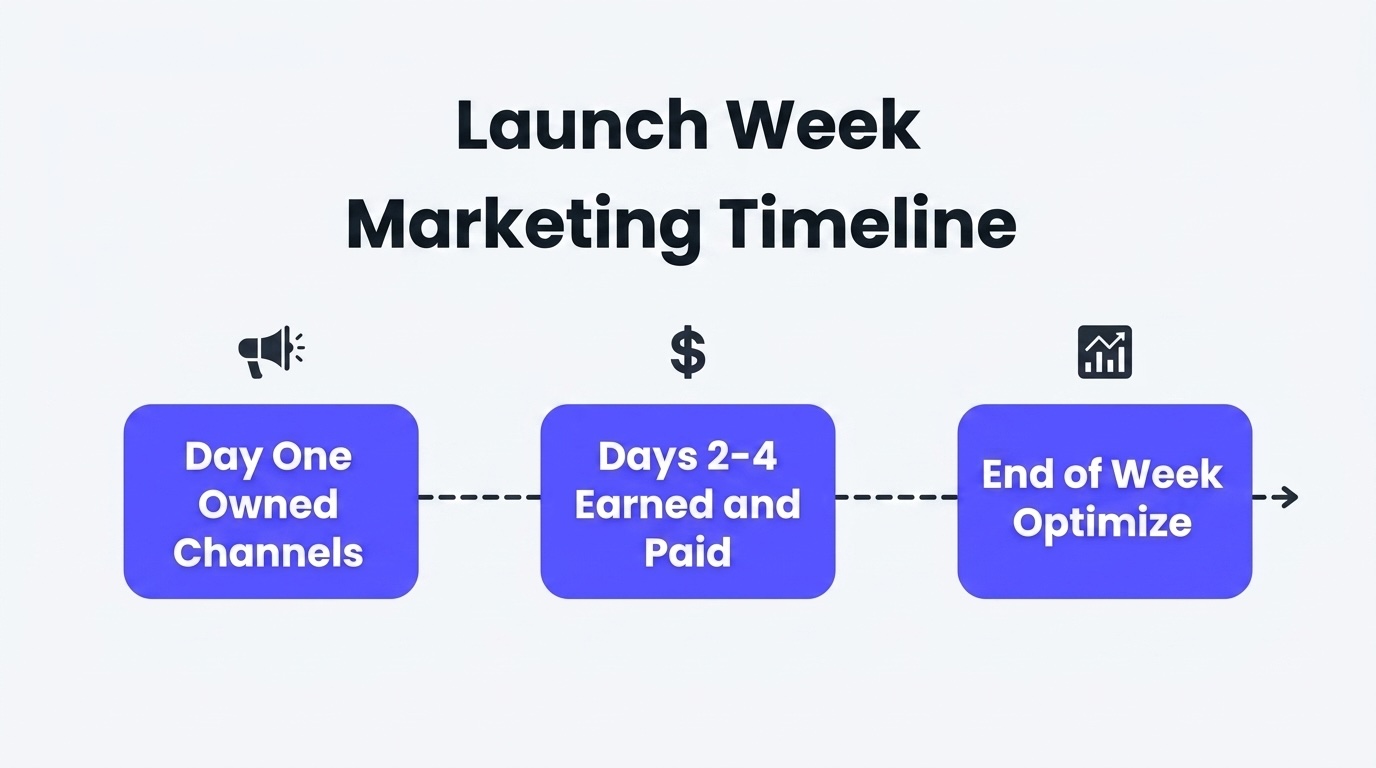
This is the week when all launch efforts fire at once. All the positioning, content, partnerships, and waitlist building from the past two months converge into a coordinated push. The point isn't to follow market trends or go viral. You have to generate enough concentrated activity that your product gets real users and real customer feedback fast.
Day One – Activate Your Owned Channels First
Launch morning is not the time for cold outreach. Your email list and personal network are the people most likely to actually sign up. Start there.
- Send a short, focused email to your full waitlist at 9 AM in your target audience's timezone. One paragraph about what is live. One link. One ask.
- Post a personal launch announcement from your founder’s LinkedIn or Twitter account. Tag the people who gave you feedback during beta by name. Personal posts pull 5-10x the engagement of company page posts.
- DM your 20 closest contacts one by one. Ask them to try the product and leave an honest review wherever you have listed it.
Days 2-4 – Expand Into Earned and Paid
Day one gives you the initial boost. Those next 72 hours are where you will find out if your launch has staying power.
- Submit to Product Hunt or a relevant subreddit – whichever community your target customer actually uses. Post Tuesday through Thursday mornings. Weekends are dead for discovery platforms.
- Turn on paid social ads pointing to your landing page. Build a lookalike audience from your waitlist emails. Start at $50-100/day and run 3-4 different ad creatives. You need creative variety to find a winner fast.
- Email 10-15 journalists or newsletter writers in your niche. Keep each pitch to three lines – what is new + one link + one sentence about why their readers should care.
End of Week — Measure, Adjust, Grow What Works
By Friday, you have five days of data and key performance indicators. That is enough to measure product launch success. Analyze success metrics to see which channels got real signups and which ones wasted money. Time to stop assuming and start optimizing.
- Rank every channel by cost per activated user – not by traffic volume and not by clicks.
- Remove ad creatives with a click-through rate below 0.8% after 48 hours of spend. Move that budget to whichever creative is actually performing.
- Look at the bug reports and feature requests from your first users. Pick the top two and tell everyone you are going to fix them.
Where to List Your Product for Maximum Early Visibility
Discovery directories are free traffic. People browsing these sites are specifically looking for new tools to try, which means they convert at a much higher rate than cold social media traffic.
- List on PitchWall – it is free, and you pitch directly to an audience of early adopters actively browsing for new products. Featured products consistently see spikes in qualified traffic and newsletter signups from people who actually want to try things.
- Post on Product Hunt on a Tuesday or Wednesday. Coordinate with your team and earliest users to leave honest reviews in the first two hours.
- Pick 3-5 niche communities. Subreddits and Slack groups are strong for B2B. Add region-specific directories too if you are targeting international users.
Post-Launch Product Marketing Strategy: How to Keep Momentum After the Early Momentum
The traffic chart after launch week always looks the same. A big boost, then a steep drop. Too many teams accept that as normal instead of doing something about it. Big mistake. SaaS products retain just 39% of users after 30 days. And poor onboarding is responsible for over 20% of voluntary customer churn.
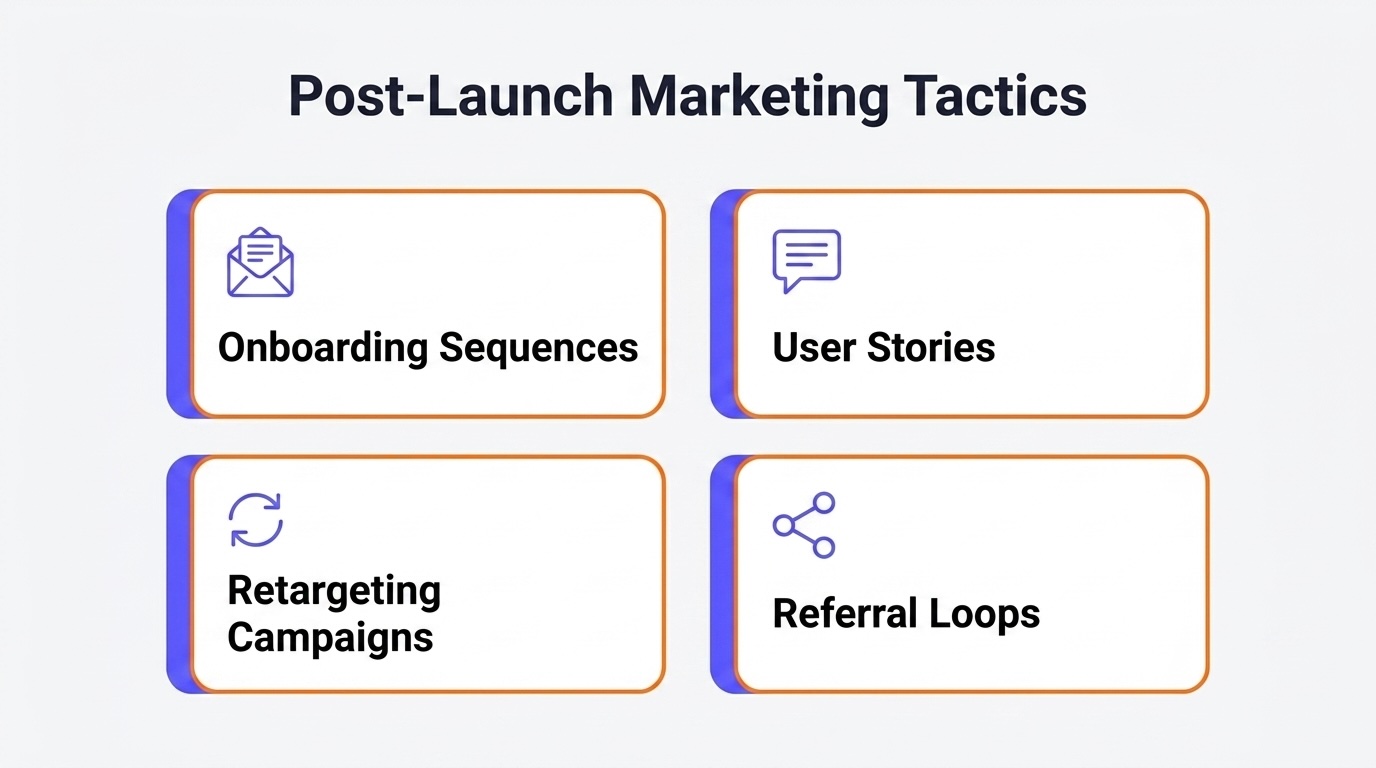
1. Turn Early Signups Into Active Users With Onboarding Sequences
A signup is not a customer. It is a person who typed their email into a form. And the biggest drop-off happens before people start using the product.
- Build a 5-email onboarding sequence. First email: welcome and one specific thing to do right now. Second email: a quick-win tutorial. Third: a use case from a real early user. Space them 2 days apart.
- Identify your product's best parts – the single action that makes users stay. For a design tool, it might be exporting the first file. For a CRM, it is adding the first deal.
- Send an email from the founder to every user who signs up in the first week. Ask what they are trying to get out of it. Those answers will be the best ad copy you have ever written.
2. Collect and Publish User Stories Within the First 30 Days
Nothing converts like a real person explaining how they use your product. Not you. Not your marketing team. The user. Their language is different from yours, and prospects trust it more.
- Email your 10 most active early users after two weeks. Give them a format: "Before [product], I [old way]. Now I [new way]." Most people are happy to share a sentence or two if you make the ask specific.
- Turn every testimonial into at least two marketing materials. A quote card for social media and a text block for your landing page. One good user story should feed multiple channels for weeks.
- Get one early user on a 3-minute video call. Screen-record them using the product. Upload it to your site and share it on LinkedIn.
3. Run Retargeting Campaigns Against Launch Week Traffic
Most people who visited your site during launch week didn't sign up. They looked, they read, they left. Retargeting puts your product back in front of them after they have had time to think – and it costs a fraction of cold acquisition because they already know who you are.
- Install your Meta Pixel and Google Tag on your landing page before launch day. Not after. If you set them up once traffic starts coming in, you lose the data from your highest-volume window.
- Build a retargeting audience from launch week visitors who didn't sign up. Show them a different angle than the original launch message – a short demo video or a user quote works better than repeating yourself.
- Cap your retargeting window at 14 days. After two weeks, intent drops and click costs climb. Spend aggressively in the first 14 days while people still remember you.
4. Build a Referral Loop Before Growth Flattens
Your users are most excited about your product right after they sign up. That excitement doesn't last. If you wait three months to ask for referrals, the moment is gone. Set this up in week one.
- After a user completes their first key action inside the product, trigger a message: "Know someone who'd use this? Share your link, and you both get [reward]." Timing this after a win gets a much higher share rate.
- Make rewards two-sided. Both the referrer and the new user get something. A free month or bonus credits.
- Use ReferralCandy or Rewardful for referral tracking. Purpose-built tools handle attribution and payout tracking much more accurately.
How to Allocate Your Product Launch Marketing Budget
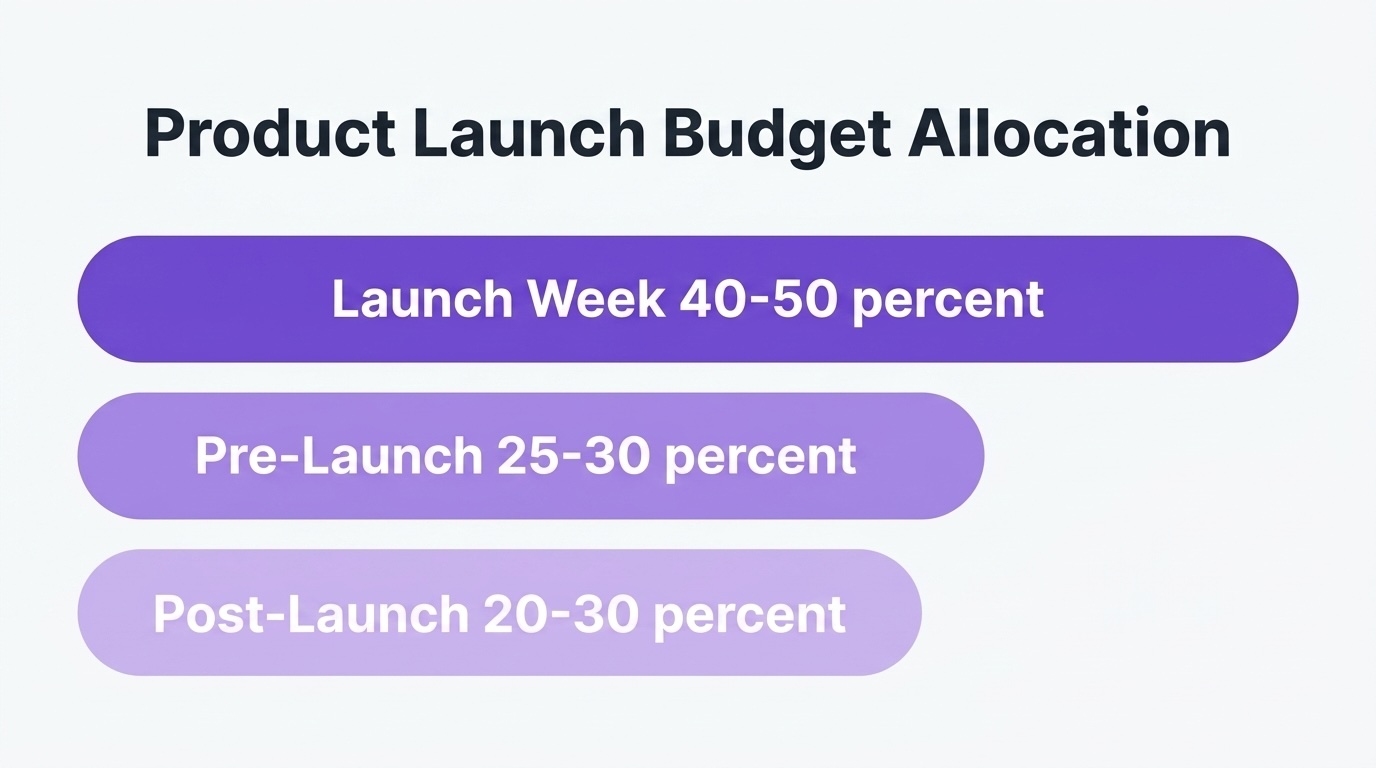
Here's how to split your product launch marketing budget.
What Percentage to Spend Pre-Launch vs. Launch vs. Post-Launch
Dividing your budget equally across three phases seems fair. But it is wrong. Focus on efficient resource allocation. Launch week deserves the biggest chunk because that is your window of highest attention and highest conversion potential. Pre-launch costs are mostly one-time. Post-launch is about efficiency.
| Phase | Budget Share | Where It Goes |
|---|---|---|
| Pre-Launch (8-12 weeks out) | 25-30% | - Landing page - Content - Waitlist ads |
| Launch Week | 40-50% | - Paid digital marketing - PR outreach |
| Post-Launch (first 60 days) | 20-30% | - Retargeting - Referral rewards |
When you are trying to keep launch costs under control, every expense gets questioned. One budget line item most founders forget: business formation. You can't open a business bank account, set up Stripe, or sign a co-marketing agreement under your personal name without creating liability problems later.
Most startup founders register an LLC before they spend anything on marketing – and a disproportionate number of them choose Wyoming. The state has no income tax and keeps ownership details private. And it charges some of the lowest annual fees in the country.
For founders trying to make the most of every dollar, those savings continue year after year instead of ending after the initial registration. Starting with a Wyoming LLC also creates a stronger foundation for growth. Investors, payment processors, banks, software vendors, strategic partners – they all expect to work with a registered business rather than an individual.
Sorting out your business formation gives you one less thing to worry about later. And it also keeps future expansion much simpler. This relatively small upfront expense helps you with day-to-day operations while reducing administrative and legal costs as the business grows.
Channels Worth Paying For (and Channels That Aren't)
Not every channel deserves ad dollars during a launch. Some channels convert better organically. Putting money behind the wrong one wastes budget and tells you nothing useful about your product.
- Paid search works if people are already searching for what you sell. If your product category is new and nobody is Googling for it yet, skip search entirely and run social ads.
- LinkedIn ads are expensive but high-intent for B2B. If your product costs $50+/month per seat, the unit economics can justify it. Below that price point, your cost per lead will probably eat into the margin.
- Free platforms like PitchWall and niche subreddits cost nothing to post on. Use accessible build tools to get a polished demo ready before you list. First impressions on discovery platforms are permanent.
Budget Allocation for Teams Under $5,000
Most indie founders don't have $20,000 for a launch. Good news: the activities with the highest return are cheap. Building a waitlist costs almost nothing. Writing content is free. Community outreach is free. The paid part is small if you are strategic about it.
| Budget Stage | Recommended Spend | What to Do | Why It Matters |
|---|---|---|---|
| Pre-Launch Waitlist Ads | $500–1,000 | Run waitlist ads on Meta or LinkedIn targeting your ideal audience. | Test your positioning and messaging before committing a larger launch budget. |
| Launch Week Ads | $1,000–1,500 | Run 3–4 ad creatives at $30–50/day each. By day three, pause the low performers and move the remaining budget to the top-performing ad. | Concentrate spending on the ads that actually convert. |
| Post-Launch Retargeting | $500–1,000 | Retarget people who already visited your site or engaged with your brand. | Retargeting typically delivers 3–5× lower cost per acquisition than cold traffic because the audience already knows your product. |
4 Businesses That Built Early Traction With a Smart Product Launch Marketing Strategy
Here are 4 businesses that took different approaches to product launch marketing. And each shows practical ideas you can adapt for your own launch.
1. DialMyCallsa
Staff notification service by DialMyCalls pushes automated voice calls and SMS messages to entire teams at once. When they launched new product features, they used their own tool to solve a problem that quietly kills most launches: internal communication strategy gaps between support, sales, marketing, and product teams during the first 24 hours.
Here's what they did during the product launch process. Ten minutes before a feature went live, every customer-facing team member received a simultaneous notification – support staff got a voice call with a product briefing, and sales reps got an SMS with updated talking points.
The same information reached every person at the same time. No one was left saying "I didn't know about that" when a new customer asked about the new feature an hour after launch.
Most companies try to handle launch-day coordination through Slack messages and emails. The read rate on a Slack message during a busy morning is nowhere close to 100%. A phone call that rings in your pocket is.
If your launch depends on every team member being on the same page at the same moment, the notification channel matters more than most founders realize.
2. Uproas
TikTok agency ad accounts by Uproas give brands access to higher spending limits and faster ad review – features that standard TikTok advertiser accounts don't include. When they launched the service itself, they used their own agency-tier infrastructure to run a successful launch campaign.
The difference showed up on day one. Their ads cleared review and went live within hours, while competitors using personal ad accounts waited 12-24 hours in review queues. They scaled daily spend past $500 on the first morning – most new TikTok accounts are hard-capped at $50/day until they build history.
Uproas also ran six completely different ad hooks in the first 48 hours, pulling performance data fast enough to identify the two winners and consolidate all spend behind them before launch week ended.
The takeaway for anyone planning an effective product launch strategy on TikTok: ad account tier directly controls how much you can spend and how quickly your ads go live. Those variables determine whether your launch window produces data or produces dead time waiting on ad approvals.
So far, we have mostly looked at software. Now let's look at another industry where launch strategy makes a huge difference.
eCommerce store owners who release new product lines or seasonal collections face the same core challenge: how do you build anticipation and convert first-time visitors into paying customers on day one?
Leaving eCommerce out of this conversation would ignore a huge part of the target market where a successful product launch strategy directly drives revenue. These next two examples come from online retail brands that treated their product releases as structured marketing campaigns – not just new items added to a catalog page.
3. IceCartel
For the iced-out chain collection by IceCartel, every release is run as a structured product launch plan with a built-in marketing cycle around it. Two weeks before the release, Instagram Stories start showing raw production footage – diamonds being set, chains being polished, pieces being photographed.
A countdown timer goes live on the product page. Their VIP email list gets a 48-hour advance notification with first access to purchase. When the drop goes live, inventory is limited. Pieces sell out in hours, not weeks.
The scarcity model does something paid ads can't: it creates urgency that compounds. Customers who miss a drop sign up for notifications on the next one. This builds a self-reinforcing waitlist that grows without any ad spend. For eCommerce brands, the "drop" format turns every new SKU into a launch event with its own built-in marketing engine.
4. Sewing Parts Online
Niche eCommerce is a different game. The audience is smaller, which means every potential buyer is super important. Generic Facebook ads won't work. The community already knows what is worth buying and what isn't.
Sewing Parts Online sells Janome sewing machines to a tight-knit community of sewing enthusiasts – and when they brought in a new Janome model, they built a 4-week launch campaign around it.
It started with a YouTube video shot by someone who actually sews. The video walked through the machine's standout features while stitching through different fabric weights. Then came a segmented email blast to Janome owners in their existing customer database, which offered a first-week exclusive discount unavailable anywhere else on the site.
The last move was the most effective. They posted in three sewing-focused Facebook groups with a casual "we just got this model in and here's what we think" tone. That community-native tone is what drove the highest conversion rate of any channel they used. They sold through the initial inventory in 11 days.
For niche eCommerce, the lesson is specific: your existing community is the launch channel, and authenticity converts better than any ad.
Conclusion
A successful product launch marketing strategy should never be built around a single date on the calendar. Build it around a sequence of actions that keeps attention growing. Give yourself enough runway to test your messaging and build an audience. Fix weak spots before launch day arrives. That is the strategy worth following every single time.
Platforms like PitchWall give founders a real audience on launch day. List your product for free and pitch it directly to early adopters who are actively browsing for new tools. Thousands of makers visit PitchWall daily – exactly the kind of audience a fresh launch needs. Submit your product now.