
We Tried Every E-Signature API — Here’s Why We Built Our Own

We didn’t set out to build an e-signature company. We were building RoostedHR, a workforce management platform, and at some point we needed electronic signatures for employment contracts, onboarding documents, policy acknowledgements. The usual HR stuff.
It seemed like it should be straightforward. Find an e-signature API, integrate it, move on… and that’s not what happened.
The evaluation that broke our budget
We did what any startup would do. We looked at the incumbents. DocuSign, HelloSign, PandaDoc, a few others. And the pricing was the first thing that stopped us cold.
DocuSign’s API plans start at $600 a year for 40 envelopes per month. Their intermediate tier jumps to $3,600 per year. If you go over your envelope limits, overage fees can run $0.50 to nearly $5.00 per envelope. And none of these plans are truly pay-as-you-go. You’re committing to annual contracts and navigating tiered pricing structures designed for enterprise procurement teams, not two founders trying to ship a feature.
We were a bootstrapped startup processing HR documents. The math was simple: at the volumes we needed, e-signatures alone would have been one of our biggest line items. For a feature that should be a checkbox, not a budget crisis.
White-labeling someone else’s problem
So we tried the middle path. We found an e-signature API provider, white-labeled their service, and built it into RoostedHR via their API. It worked, technically. Documents got signed. Audit trails were generated.
But the cost was $0.60 per document.
Sixty cents doesn’t sound like a lot… until you do the multiplication. We were building a workforce management platform. Our customers weren’t signing one document a quarter. They were onboarding employees, sending policy updates, collecting tax forms. The volume adds up fast.
At that price, we couldn’t absorb the cost ourselves. So we passed it on to our customers, at no margin. And predictably, they barely used it. Nobody wants to pay a premium for something that feels like it should just be part of the platform. The feature that should have been a major selling point for RoostedHR turned into a feature nobody touched.
It was a total bust. A genuinely useful capability that we had to artificially restrict because the underlying economics didn’t work.
Then it stopped working internationally
The cost issue would have been bad enough on its own, but then we ran into compliance problems. We had a customer in France who simply couldn’t use the e-signature feature. The provider we’d white-labeled didn’t meet the legal requirements for electronic signatures in their jurisdiction. Full stop.
That was the moment the situation went from frustrating to untenable. We were building an HR platform for companies operating across borders, and our signature feature only worked in some of them. You can’t sell workforce management software internationally while telling customers in certain countries that they’ll need to print documents and sign them with a pen.
Building it ourselves
So we started building. Not because we wanted to become an e-signature company, but because we’d exhausted the alternatives. The off-the-shelf options were either too expensive, too limited in coverage, or both.
What we learned quickly is that e-signatures look simple from the outside, and they are absolutely not simple underneath. Document rendering, multi-party signing workflows, audit trail generation, template management, email deliverability, all of that is table stakes. The real complexity is compliance. Every country has its own legal framework for electronic signatures. The EU has eIDAS. The US has ESIGN and UETA. France has specific requirements around secure electronic signatures. Getting certified and ensuring legal validity across jurisdictions is a year-long project, not a weekend hack.
It took roughly six months of ideation and architecture… then another full year of development, compliance work, and getting the right certifcates in 54 countries before we reached core feature completeness in late 2025. That’s a significant investment for what started as “we just need documents signed.”
The realization
But something interesting happened along the way. The tool we built for ourselves was… genuinely good. Fast, cheap to operate, legally solid across dozens of markets, and developer-friendly because we’d built it for developers. For ourselves.
And we realized we weren’t the only startup that had been through this exact cycle. Every SaaS company that needs e-signatures eventually hits the same wall. DocuSign charges roughly 170 times what it actually costs to process an envelope at our margins. Even the cheaper alternatives like DocuSeal, which charges $0.20 per document via API plus $20 per month per admin user, are still meaningfully more expensive than they need to be, especially for multi-tenant SaaS setups where per-user base fees compound fast.
The market was basically two options: enterprise pricing you can’t afford, or roll your own and spend a year on compliance. There was no real DocuSign alternative for developers who just wanted a clean API at a fair price.
170x cheaper than DocuSign
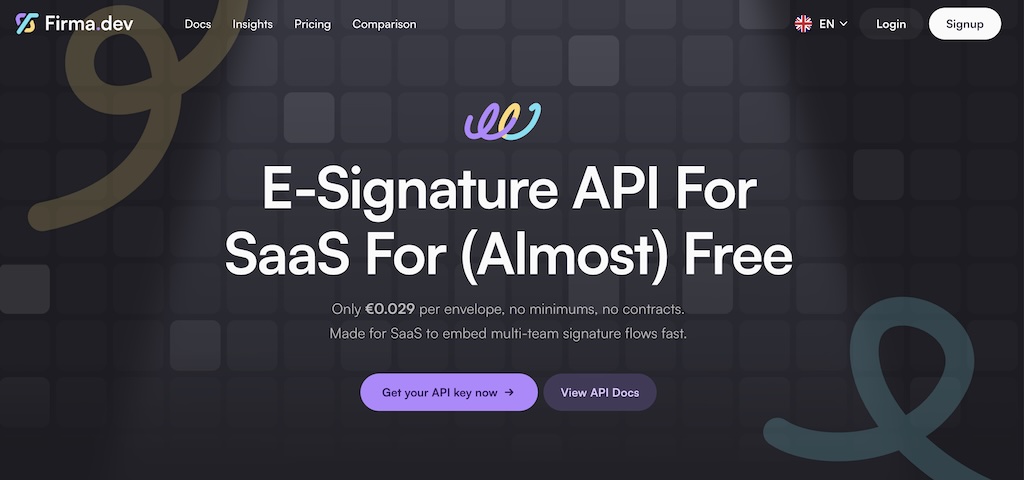
We pulled the e-signature engine out of RoostedHR and launched Firma.dev, the cheapest e-signature API on the market. True pay-as-you-go at $0.029 per envelope. That’s 2.9 cents. No contracts, no monthly minimums, no sales calls. You get an API key and start building.
For context on where that sits: DocuSign’s API plans work out to anywhere from $1.25 to $5+ per envelope depending on your plan and volume. DocuSeal charges $0.20 per document plus base fees. Firma.dev is a fraction of either.
We built what we wished had existed when we were evaluating options for RoostedHR. And now any SaaS company, startup, or developer can embed e-signatures into their workflows without worrying about per-document costs killing their margins. Customer onboarding, contract management, compliance workflows, whatever the use case is, you can roll it out across all of your users without the fear that adoption will bankrupt the feature.
It’s legal in 54 countries. It supports SES and Advanced Electronic Signatures under eIDAS, plus ESIGN, UETA, and frameworks like HIPAA and FDA 21 CFR Part 11 in the US. It comes with embedded editors for both templates and signing, so your users never leave your app. And it includes Customer Workspaces that give each of your customers their own partitioned environment with isolated templates and usage tracking.
What we learned
The conventional wisdom in SaaS is “don’t build what you can buy.” And that’s usually right. But it assumes the buy options are reasonably priced and fit your use case. When they’re not, when every vendor is either overcharging or under-delivering, sometimes the thing you build for yourself turns out to be the thing the market actually needs.
We didn’t plan to start an e-signature company. We just needed signatures in our HR platform without going broke. The fact that solving our own problem created something worth sharing… honestly, that’s the best kind of accident.
If you’re building a SaaS product and e-signatures are on your roadmap, you can get started with Firma.dev for free. No credit card required.
Author Bio: Derick Dorner is the co-founder of Firma.dev, the developer-first e-signature API built for startups and SaaS companies. Before spinning out Firma.dev, Derick co-founded RoostedHR a workforce management platform where the e-signature engine was originally built as an internal tool. He’s based in Barcelona.