



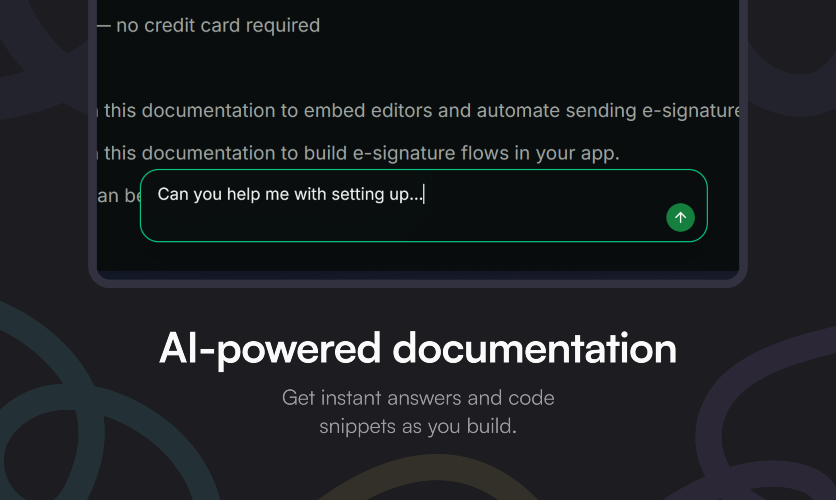
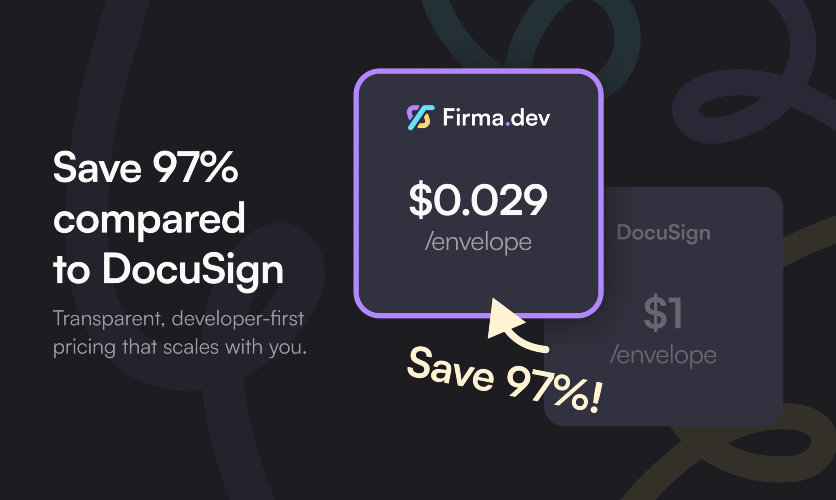
Firma.dev is a pay-as-you-go e-signature API built for developers at startups and mid-sized SaaS companies. It lets businesses send legally binding documents for signing at €0.029 per envelope (roughly 3 cents USD), with no monthly fees, no minimums, and no contracts. The core product is a REST API that handles the full signing lifecycle: creating templates, defining signer roles and fields, sending envelopes, collecting signatures, and delivering completed documents. Firma.dev also provides embeddable editors for both template creation and document signing, which means developers can build the entire e-signature experience directly into their own applications without redirecting users to a third-party interface. Most teams complete their integration in hours rather than weeks. For SaaS companies that need to offer e-signatures to their own customers, Firma.dev provides Customer Workspaces. These are private, partitioned spaces where each customer gets isolated templates, separated envelope usage, and their own signing workflows. It's a clean multi-tenant architecture without the complexity that usually comes with it. On compliance, Firma.dev is designed to support major e-signature frameworks across multiple jurisdictions. In the US, that includes alignment with the ESIGN Act and UETA. In the EU and UK, the platform supports Simple Electronic Signatures (SES) and Advanced Electronic Signatures (AdES) under eIDAS. All data is processed and stored exclusively within the EU on AWS infrastructure in Paris and Stockholm, with GDPR compliance built into the platform's architecture from the ground up. The pricing model is straightforward. Every envelope costs €0.029. There are no tiers, no per-seat charges, and no overage penalties. Developers can get started with a free API key and only pay for what they send. For context, legacy e-signature providers like DocuSign can cost upwards of €4.90 per envelope on their standard plans, making Firma.dev roughly 170 times more affordable. Firma.dev also ships with AI-ready infrastructure, including MCP (Model Context Protocol) servers that let AI tools and coding assistants interact directly with the platform's API and documentation. The Docs MCP server provides instant access to integration guides, while the Data MCP server exposes 84 tools for managing templates, signing requests, and workspace configuration programatically. The platform currently serves thousands of developers across 54 countries, with headquarters in Barcelona.
Published At