
Skygen AI vs ChatGPT: Which One Actually Automates Your Business
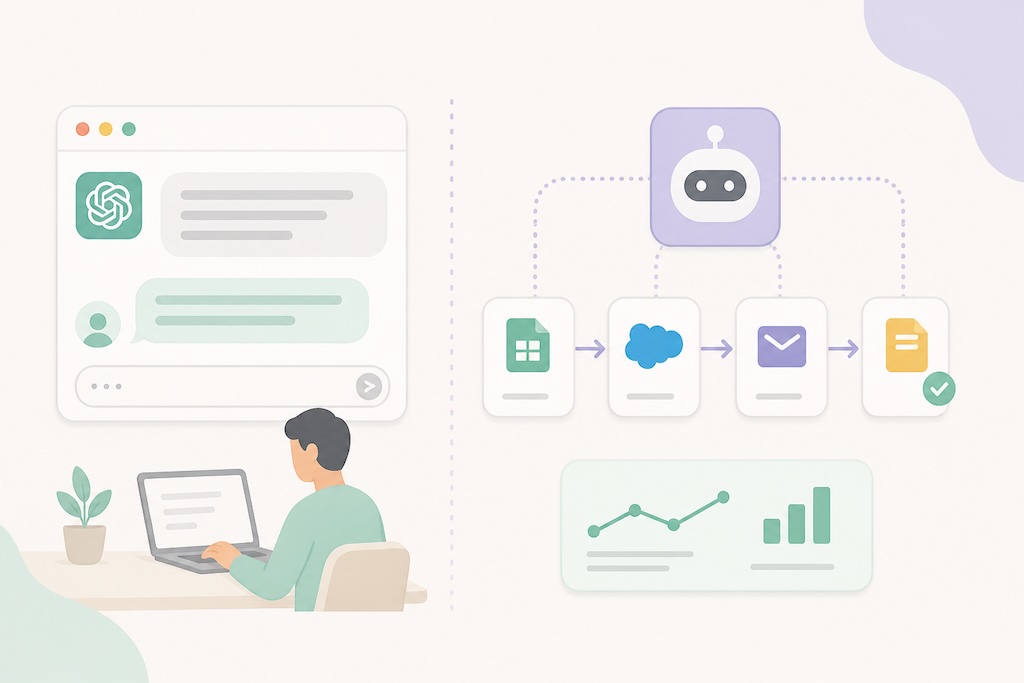
Picking an AI tool based on what it can do in a demo is one thing. Picking one based on what it does at 9am on a Tuesday when your team has forty tasks in the queue is another.
Two Different Tools Solving Two Different Problems
ChatGPT is a conversational AI built around language generation. Ask it a question, give it a prompt, and it produces a response. It's useful for drafting, summarizing, brainstorming, and answering queries. A significant number of professionals use it daily and find genuine value in it. That's not in dispute.
What ChatGPT isn't — and wasn't designed to be — is a workflow automation platform.To understand what that actually involves at an operational level, it's worth looking at how workflow automation systems are defined and implemented in modern business environments. It doesn't connect to your CRM. It doesn't trigger actions based on business logic. It doesn't run a process end-to-end without a human feeding it each step. Every output requires a human in the loop to initiate, review, and act on it.
Skygen AI is built around a different premise. The platform deploys AI agents that execute multi-step business workflows autonomously — connecting to existing tools, running repeatable processes, and delivering outputs without requiring manual input at each stage. The comparison between the two isn't really about which AI is more capable in a general sense. It's about what kind of work each one is structured to handle.
Where ChatGPT Fits and Where It Stops
ChatGPT is genuinely useful as a productivity tool for individual tasks. A marketer using it to draft ad copy, a support agent using it to rephrase a response, a founder using it to stress-test a pitch — these are legitimate use cases where the tool delivers real value.
The limitation shows up at the workflow level. If your team's process involves ten steps, ChatGPT can help with two or three of them, on demand, when someone thinks to use it. The other seven still happen manually. The coordination between steps still happens manually. The tracking, the handoffs, the consistency checks — all manual.
For individual contributors, that's manageable. For teams trying to scale output across multiple clients, channels, or product lines, the manual layer compounds quickly. An AI that requires a human prompt for every action isn't automating a workflow — it's accelerating individual tasks inside a workflow that still runs on human time.
What Skygen AI Handles Differently
The Skygen AI platform is structured around AI agents that operate within defined business logic. Rather than responding to prompts, these agents are configured to run processes — taking inputs from connected systems, working through a sequence of steps, and passing outputs to the next stage without waiting for manual instruction between each one.
A content operation using Skygen AI might have agents handling topic research, brief generation, SEO analysis, and performance tracking as a connected sequence. Each stage feeds the next. The team's involvement is in reviewing outputs and making judgment calls, not in moving information between steps.
That distinction — between a tool that responds and a platform that runs — is where the practical difference becomes clearest for business use.
The Integration Question
ChatGPT can be connected to external tools through plugins and the API, and developers can build integrations on top of it. But that requires technical resources to implement, and the resulting setup is a custom build that a business then owns and maintains.
Skygen AI is built integration-first. The platform is designed to connect to the tools businesses already use — CRMs, content management systems, analytics platforms, project management tools — through pre-built integrations and API connectivity. Workflow automation doesn't require an engineering project before it starts delivering value.
For a marketing agency or operations team without a dedicated technical function, that difference in implementation overhead matters more than it might appear in a feature comparison.
Consistency at Scale
Here's something that doesn't come up often enough in these comparisons: consistency. ChatGPT's outputs vary based on how prompts are written, who writes them, and when. Two team members asking for the same thing in slightly different ways will get different results. That's inherent to how large language models work in a prompt-response model.
Skygen AI agents run the same logic the same way every time. When a workflow is configured, it executes consistently across every instance — whether it's processing ten briefs or three hundred. For businesses where output quality and process reliability matter, that consistency isn't a minor detail. It's the point.
Which One Is Right for Your Operation
If the primary need is a capable assistant for individual tasks — drafting, ideation, summarization, quick research — ChatGPT is a reasonable choice and widely accessible. Most professionals already have access to it and have built habits around using it.
If the need is to automate repeatable business workflows, reduce manual coordination, and scale output without adding headcount, ChatGPT isn't really competing in that category. Skygen AI is built for that specific problem: replacing the manual layer of business operations with AI agents that run processes rather than answer questions.
The two tools can coexist. Some teams use ChatGPT for open-ended creative tasks and Skygen AI for structured operational workflows. The mistake is expecting one to do the job of the other — particularly expecting a conversational AI to function as a business automation platform just because both involve AI under the hood.
The Practical Takeaway
At a certain point in a business's growth, the question stops being "which AI can produce the best output" and becomes "which tool can run our operations reliably while the team focuses on higher-value work." Those are different questions, and they point toward different tools.
For teams evaluating automation seriously, Skygen AI and ChatGPT occupy different positions — and understanding that distinction before committing to either saves a significant amount of time spent trying to make the wrong tool do the right job.