
EmDash: The Modern CMS Trying to Replace WordPress
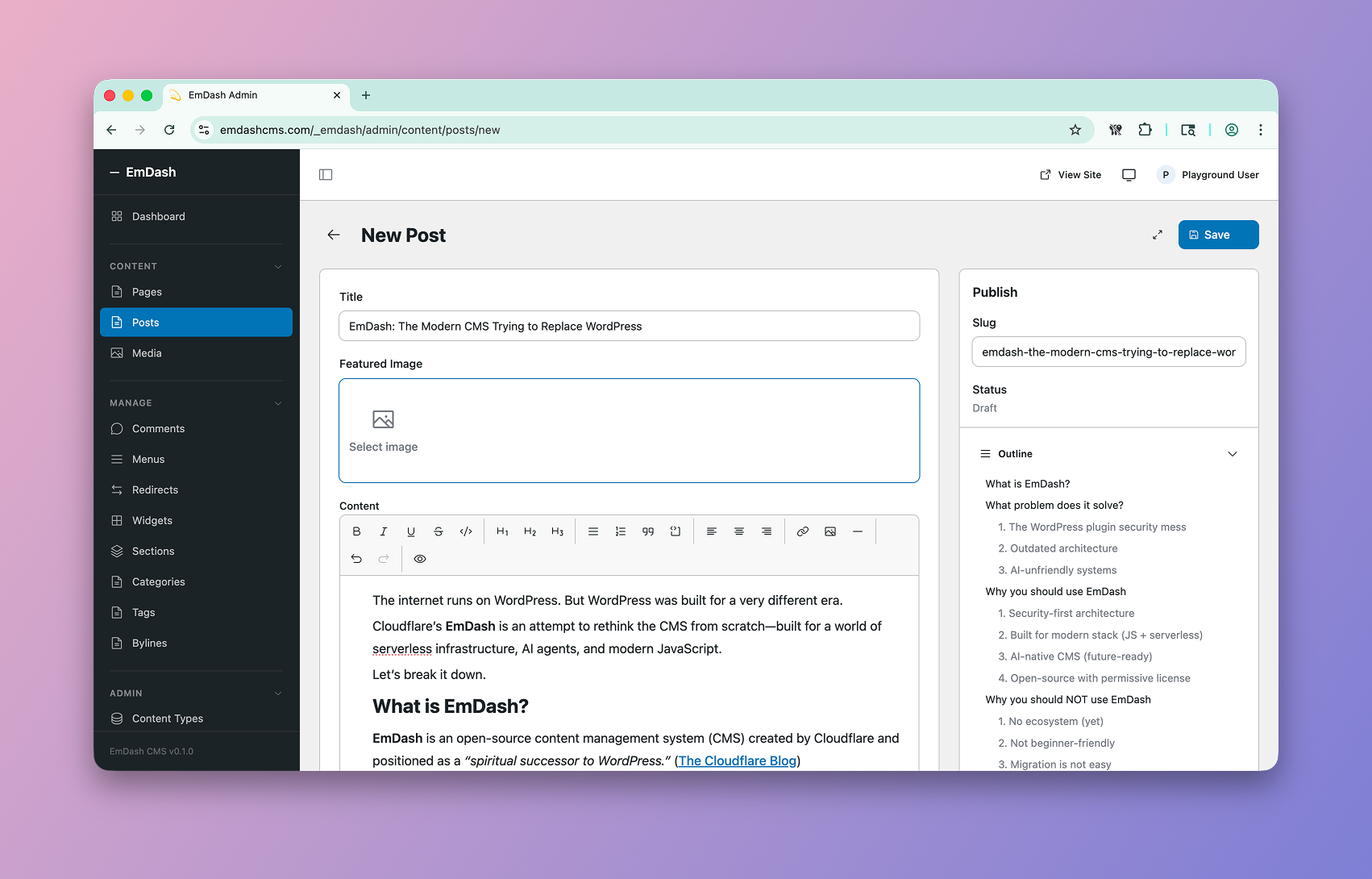
The internet runs on WordPress. But WordPress was built for a very different era.
Cloudflare’s EmDash is an attempt to rethink the CMS from scratch - built for a world of serverless infrastructure, AI agents, and modern JavaScript.
Let’s break it down.
What is EmDash?
EmDash is an open-source content management system (CMS) created by Cloudflare and positioned as a “spiritual successor to WordPress.” (The Cloudflare Blog)
At its core, EmDash is:
- Built in TypeScript (not PHP)
- Serverless-first, designed to run on modern infrastructure
- Powered by Astro
- AI-native, meaning it’s designed to work with AI agents out of the box
- Open-source under an MIT license (more permissive than WordPress’s GPL)
It aims to offer the same core promise as WordPress—publishing content easily—but with a modern architecture.
What problem does it solve?
1. The WordPress plugin security mess
The biggest issue EmDash targets is plugin security.
- Around 96% of WordPress vulnerabilities come from plugins (Patchstack)
- Plugins often have full access to database + filesystem
- A single vulnerable plugin can compromise the entire site
EmDash fixes this by:
- Running each plugin in an isolated sandbox (Dynamic Workers)
- Forcing plugins to declare explicit permissions
- Preventing one plugin from affecting the whole cms
2. Outdated architecture
WordPress was built before:
- Serverless computing
- Edge networks
- Modern JS frameworks
EmDash rebuilds the CMS for:
- Global edge deployment
- Auto-scaling (scale to zero → millions)
- Modern developer workflows
3. AI-unfriendly systems
Traditional CMS workflows are manual and rigid.
EmDash is designed for:
- AI agents to update content, restructure pages, migrate data
- Programmatic control over CMS operations
Why you should use EmDash
1. Security-first architecture
This is the strongest reason.
- Plugin isolation is a fundamental improvement
- Reduces the biggest attack vector in CMS ecosystems
If you’re building for enterprise or security-sensitive apps, this matters.
2. Built for modern stack (JS + serverless)
If you're already using:
- Astro / Next.js / modern frontend
- Edge deployments
- Cloudflare Workers
EmDash fits naturally into your workflow.
3. AI-native CMS (future-ready)
This is subtle but powerful.
- AI can manage content, migrations, structure
- Enables automated websites
This aligns with where tools like your own SaaS + AI workflows are going.
4. Open-source with permissive license
- MIT license = easier for startups and enterprises
- No GPL restrictions
This increases adoption potential in serious products.
Why you should NOT use EmDash
Let’s be real—it’s not ready for most people.
1. No ecosystem (yet)
WordPress has:
- Thousands of plugins
- Themes
- Massive community
EmDash has:
- Almost no plugin ecosystem
- Limited tooling
This is a huge disadvantage.
2. Not beginner-friendly
Early feedback suggests:
- It’s developer-focused
- Less polished for non-technical users
If your audience is:
- Bloggers
- Small businesses
- Non-tech users
WordPress still wins.
3. Migration is not easy
Even if tools exist:
- WordPress plugins/themes won’t just work
- Likely requires rewriting everything
That’s a big switching cost.
4. Early-stage product (v0.1)
- Still in developer preview
- Bugs, missing features, rough edges expected
- Self-hosting will be complicated due to Sandboxing
5. Infrastructure lock-in
While not locked-in:
- Works best on Cloudflare infrastructure
- Feels like a strategic product to push Workers
This may not align with everyone.
Final Take
EmDash is not “the next WordPress” today.
But it might define what CMS looks like in the next 5–10 years.
Use EmDash if:
- You’re a developer
- You want modern architecture
- You care about security and AI workflows
Avoid EmDash if:
- You want stability and ecosystem
- You need plug-and-play simplicity
- You’re building for non-technical users
Leave you comment for Emdash.