
Why cross-platform play is still a mess in 2026
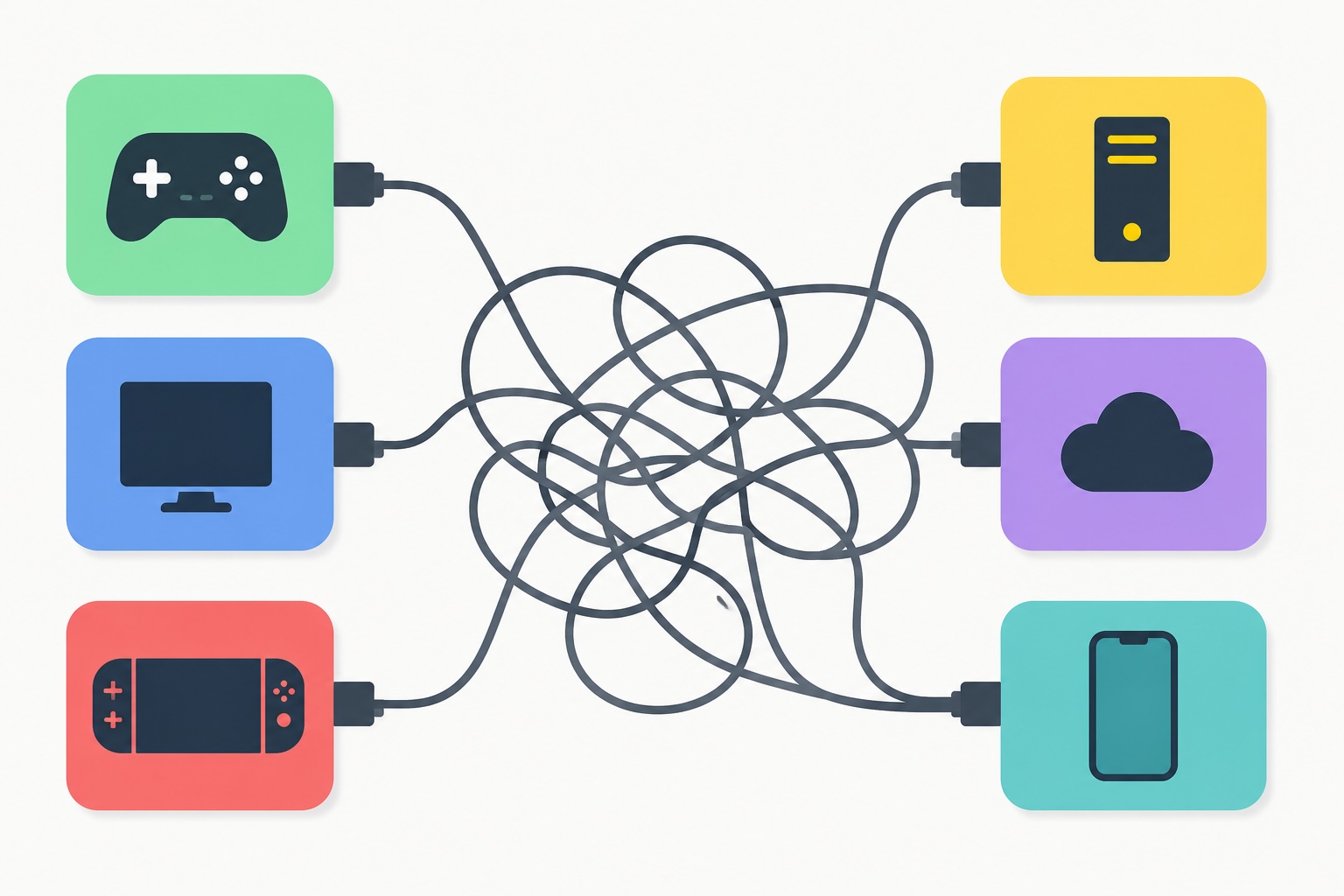
A few weeks ago, four of us tried to start a new co-op game. I'm on PC. Two friends are on PS5, and the fourth is on a Switch, and he is not buying another console, he has told us this many times. Somebody suggested Stardew Valley. Lovely game, has had multiplayer since 2018, and it has no crossplay at all, between any platforms, which surprised everyone in the chat except me. Somebody suggested Minecraft, which would almost have worked, except the PC people own the Java edition and Java only connects to Java. The consoles run Bedrock. Same name on the box. Two separate games.
An hour of this. We played Rocket League again.
I maintain a database that tracks crossplay support, so an evening like that is professionally embarrassing, and it's also why I want to write down what I think is actually going on. Cross-platform play stopped being a hard technical problem years ago. The engineering got solved, then the politics got solved, and nobody ever solved the data.
The engineering part
Getting one game to talk to itself across PlayStation, Xbox, PC and Switch was never really a networking problem. A packet doesn't know what box it came from. The expensive part is everything sitting on top of the connection: each platform has its own accounts, its own friends list, its own matchmaking, its own certification process, and a studio that wants crossplay has to glue a PSN account, an Xbox gamertag and a Steam ID into one persistent player, then keep purchases and progression and bans consistent across all of them, forever, through every patch. Voice chat alone is basically a small legal document. And somewhere in there you have to decide whether mouse players get matched against controller players in a shooter, which people are still arguing about and probably always will be.
For a long time only very large studios could afford all of that. The thing that changed it, more than anything else, was Epic taking the backend they'd built for Fortnite and giving it away as Epic Online Services. Free, works with any engine, handles the cross-platform accounts and lobbies and matchmaking. There are competing services now too. A five-person team can get crossplay running in weeks. I've watched it happen.
Then the politics
The tech was ready well before the permission was. Sony blocked crossplay with other consoles for most of the PS4 era, and the whole standoff went public in 2018 when Fortnite players discovered that an account which had touched PSN couldn't even log in on a Switch. People were genuinely furious about that one. Sony opened a crossplay beta that September, and after that it gradually became normal policy everywhere.
Here's the thing though. Because permission arrived game by game, the support arrived game by game. In patches. Unevenly. Some games connected the consoles to each other and never got around to PC. Some let you match together but not invite each other. Some added crossplay without cross-progression, so you can join your friend's lobby while your unlocks sit on the other platform. At some point "supports crossplay" stopped meaning anything specific at all.
The data is the actual problem
This is the layer I deal with every day, so forgive some ranting.
There is no official, machine-readable source anywhere that says which games support cross-platform play between which platforms. None. Store pages mention it inconsistently or not at all. Publishers announce it in a blog post, then change the behavior in a patch eight months later and update nothing.
Crossplay is a property of a pair of platforms within a game, and almost every list on the internet treats it like a single on/off switch for the whole title. Four platforms gives you six pairs, and each pair can independently be yes, no, or yes-with-exceptions. Rocket League, everything connects to everything. Stardew, nothing connects to anything. Minecraft, depends which Minecraft. None of this is printed on the tin.
The best public source is honestly Wikipedia's list of cross-platform games, and I have real respect for it, it's volunteers keeping a giant hand-edited table alive. But a table like that can't answer the question people actually have, because the question is never abstract. It's: the four of us, on these specific machines, tonight. What works?
Our own database sits at a little over 6,000 games now, roughly 1,300 of them multiplayer, each with up to six pair rules, and the maintenance never ends because the answers decay. A pair that was broken at launch quietly starts working in patch 1.8. A port ships without the crossplay everyone assumed it would have. I find out from patch notes, from forum threads, occasionally from a user telling me my data is wrong, and sometimes they're right. I understand completely why no publisher wants to own this dataset. There's no money in it. But since nobody owns it, every gaming group on earth re-derives it from scratch in their group chat, every week, forever.
So, tools
My answer was to treat crossplay as a matching problem. That became PickThe.Games: each person in a group picks their platforms, everyone swipes yes or no on games, and it finds the overlap, checking every platform pair rather than treating crossplay as one checkbox. The argument that used to eat half our evening takes a few minutes now. There's a version at pickthe.games/try that needs no account, if you're curious what pair-level checking looks like in practice.
I don't think this is just me, either. Game discovery tooling is having a quiet moment. Search to Play is doing the Goodreads thing for game libraries. CharacTour goes at the same problem from a weirder angle, matching you to fictional characters in movies and games instead of genre tags. Every storefront ever built is designed to sell a game to one person. Multiplayer doesn't happen to one person.
What would actually fix it
Structured data at the source. If store APIs exposed crossplay per platform pair, per mode, most of this article would be obsolete and I would honestly be fine with that. Publishers already attach machine-readable metadata to product pages for ratings, FAQs, and carousels. Schema markup generators make that labeling routine for teams that don't want to hand-write JSON-LD. Crossplay pair rules are the same idea with a field name nobody agreed on. There are small signs of movement, store pages do label crossplay more often than they did two years ago. It's slow.
If you're shipping a multiplayer game in 2026, the situation is simple. The middleware is free. The platform holders will say yes. Players assume crossplay exists by default. The only thing they cannot do is find out whether it covers their particular mix of hardware, so write down which pairs work, somewhere public, and keep it current when a patch changes the answer. That's the entire ask.
We did eventually pick a new game, by the way. It only took me building a database first.