
How Community Banks Are Using Branch Management Software to Cut Wait Times and Win More Customers
Introduction
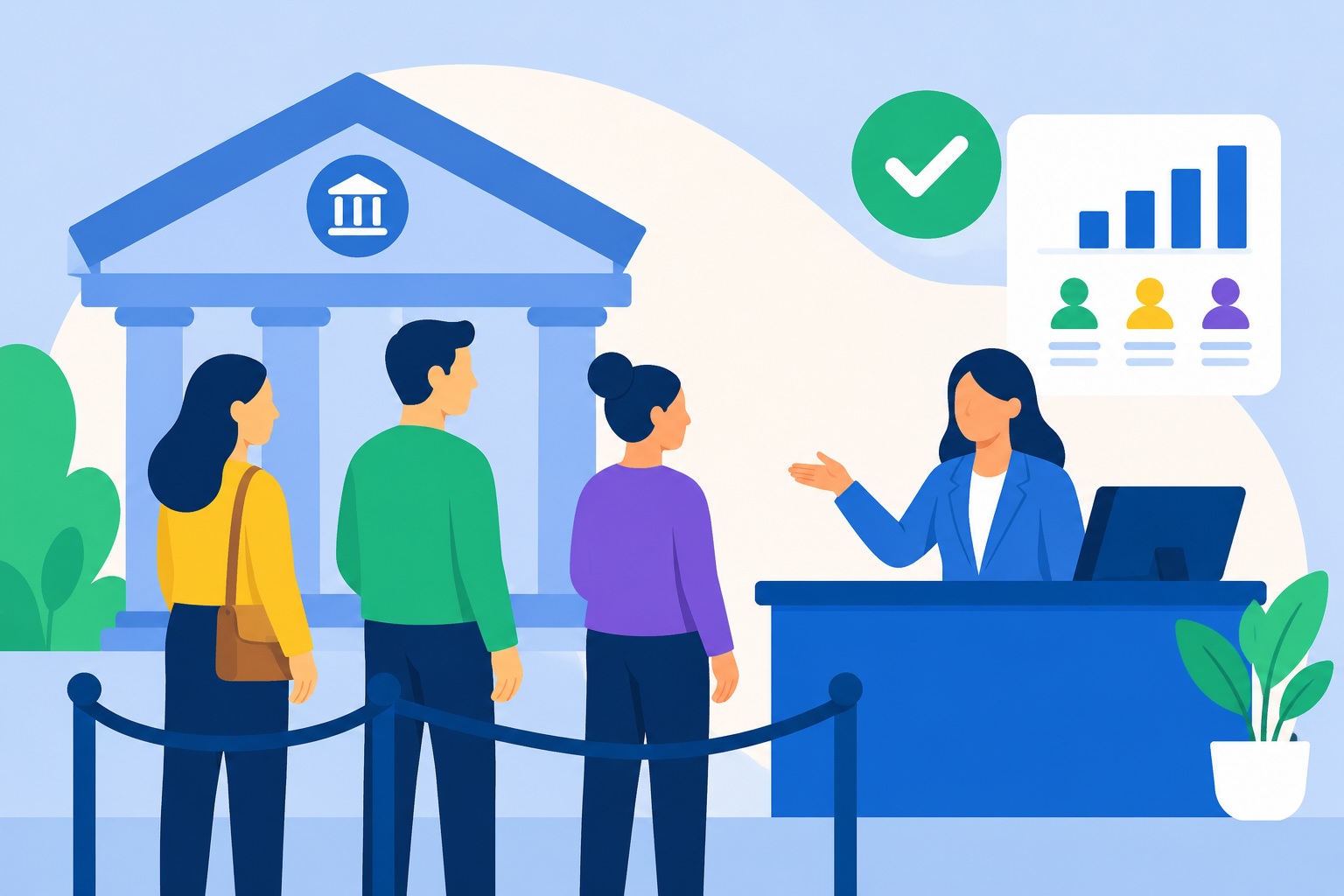
Walk into a busy bank branch on a Friday afternoon and you’ll likely see the same scene: a packed lobby, a single teller window open, and customers checking their phones as the minutes tick by.
For community banks and credit unions, that experience isn’t just frustrating it’s a competitive liability. Digital-first neobanks don’t have lobbies. They don’t have wait times. And they’re aggressively targeting the same customers community institutions depend on.
The response? A growing number of community banks and credit unions are turning to branch management software to modernize the in-branch experience not by eliminating the human touch, but by making it work smarter.
What Is Branch Management Software?
Branch management software is a category of technology designed to help financial institutions manage and optimize everything that happens inside a physical branch: from how customers are queued and served, to how staff are scheduled, to how branch performance is measured over time.
At its core, it typically includes four interconnected capabilities:
1. Appointment Scheduling
Customers can book branch visits in advance online or via mobile, choosing a specific time and service type. This eliminates the surprise walk-in surge and lets staff prepare for each interaction.
2. Lobby Management
Digital queue management replaces the paper sign-in sheet. Customers check in on arrival, are directed to the right service area, and can see estimated wait times, reducing perceived wait and improving satisfaction.
3. Staff Scheduling
Workforce management tools help branch managers build schedules that align staffing levels with predicted traffic patterns, reducing idle time during slow periods and understaffing during peaks.
4. Branch Analytics
Real-time and historical data on foot traffic, wait times, service duration, and staff utilization gives managers the visibility they need to make decisions based on facts rather than gut feel.
Together, these capabilities shift branch operations from reactive to proactive.
Why Community Banks Are Prioritizing This Now
The pressure on community financial institutions has never been higher. Here’s what’s driving the shift:
- Rising customer expectations.: Consumers who book restaurant tables, doctor appointments, and car services online expect the same convenience from their bank. Walk-in-only branch models feel increasingly outdated.
- Staffing pressures.: Post-pandemic, many branches are running leaner. Getting more out of existing staff without burning them out requires smarter scheduling tools, not just longer hours.
- Competition from digital banks.: Neobanks don’t compete on branch convenience; they compete by eliminating the branch entirely. Community institutions need to make the branch experience genuinely better, not just comparable.
- Data gap.: Many branch managers are still relying on manual observation or paper logs to understand how their branch is performing. Without data, improvement is guesswork.
Real-World Impact: What Banks Are Seeing
Institutions that have deployed branch management software typically report improvements across several metrics:
- Shorter wait times.: Appointment scheduling spreads demand across the day rather than clustering it at peak hours. Lobbies that once had 20-minute waits can see that drop to under 5 minutes on scheduled visit days.
- Higher staff utilization.: When managers can see traffic patterns by hour, day, and week, they schedule staff to match demand, reducing both overstaffing costs and understaffing stress.
- Better member satisfaction scores.: The subjective experience of a branch visit improves significantly when customers feel organized, informed, and respected for their time.
- Actionable branch data.: For the first time, branch managers can compare performance across locations, identify outliers, and build the business case for staffing or process changes.
Reserve with Google: A Differentiator Worth Noting
One feature gaining traction in branch scheduling is Reserve with Google an integration that lets customers book a branch appointment directly from a Google search or Google Maps listing, without visiting the bank’s website.
For community banks trying to capture new customers who are searching locally, this is a meaningful acquisition touchpoint. It lowers the friction between “I need to visit my bank” and “appointment booked” to just a few taps.
Very few branch software providers have built this integration. For institutions that have it, it’s becoming a quiet competitive edge.
Choosing the Right Branch Management Software
Not all branch management platforms are built for community financial institutions. Enterprise solutions designed for large national banks often bring unnecessary complexity and steep price tags that don’t suit a 10 to 50-branch institution.
When evaluating options, community banks and credit unions should look for:
- Specialization in financial services: does the vendor understand regulatory context, compliance requirements, and the specific workflows of a bank branch?
- Integrated solution suite: appointment scheduling, lobby management, staff scheduling, and analytics should work together, not as disconnected point tools.
- US-based support: for mission-critical branch operations, implementation support and ongoing help from a domestic team matters.
- Scalability: the software should scale from a handful of branches to dozens without requiring a platform switch.
- Analytics depth: surface-level dashboards aren’t enough; look for tools that surface actionable insights, not just data.
The Bigger Picture
Branch transformation isn’t about choosing between digital and physical. It’s about making physical worth choosing.
Community banks and credit unions have a genuine advantage over digital-only competitors: the ability to build real, human relationships with members. Branch management software doesn’t replace that advantage. It removes the friction that gets in the way of it.
When a member books an appointment, walks in on time, is greeted by name, served efficiently, and leaves satisfied, that’s a loyalty moment that no app can replicate.
The tools to make that happen consistently are available now. The question is which institutions will move first.