
AI Visibility: Why Traditional SEO Is No Longer Enough in the Age of ChatGPT, Gemini, and AI Search
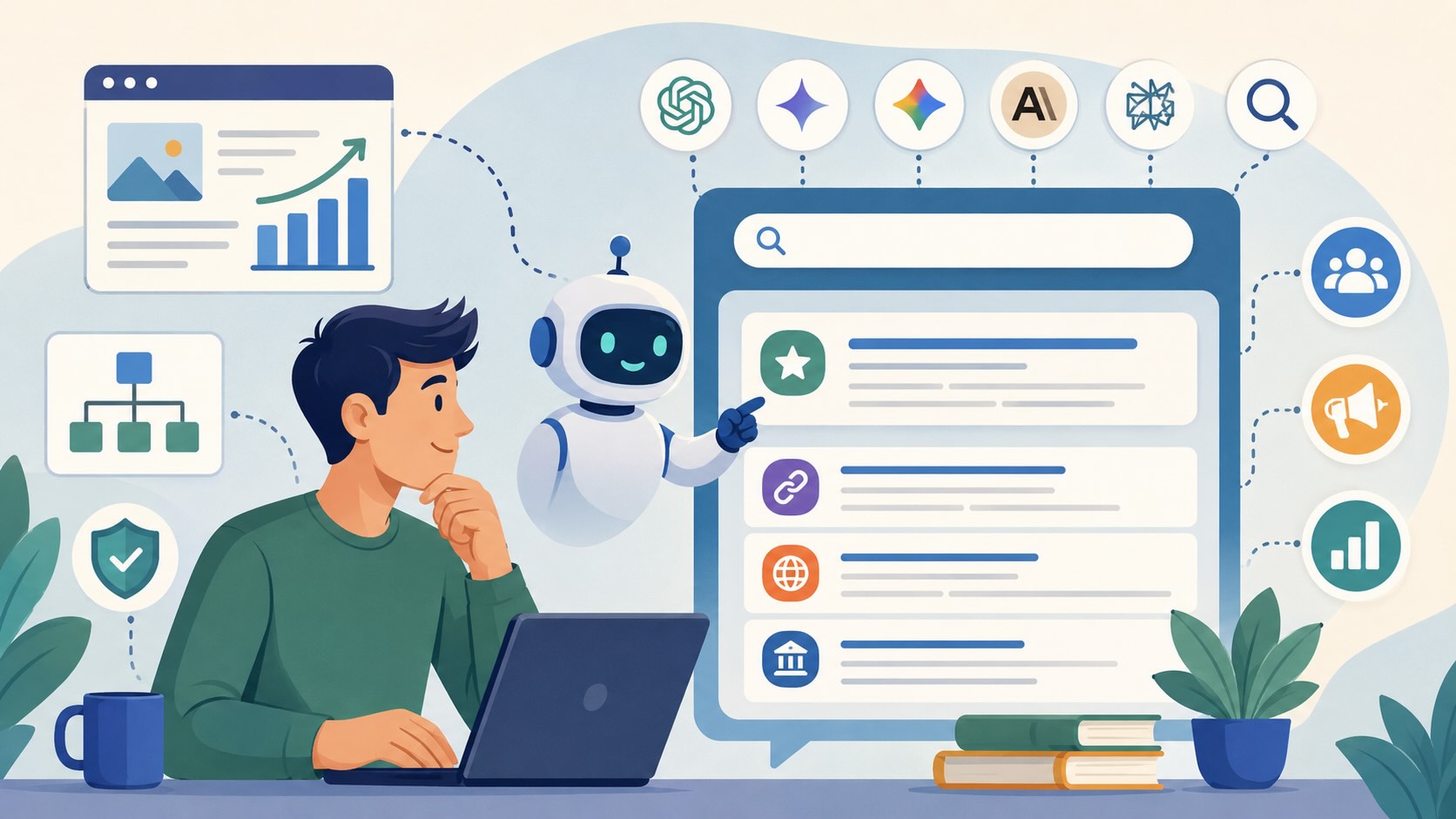
Search Has Changed. Most Marketing Teams Haven't.
For more than two decades, digital marketing revolved around a simple goal: rank higher on Google.
The formula was straightforward. Improve your website, target relevant keywords, earn backlinks, and climb the search engine results page.
But today, a growing percentage of online discovery no longer starts nor ends with traditional search results.
Users are asking ChatGPT, Gemini, Claude, Perplexity, and Google AI Overviews for answers instead of clicking through ten blue links. These platforms don't simply rank content. They synthesize information, summarize multiple sources, and generate direct responses.
This shift has introduced a new challenge for marketers, founders, and SaaS companies:
Can AI systems find, trust, and cite your brand?
That challenge is what many marketers now call AI Visibility.
What Is AI Visibility?
AI Visibility refers to a brand's ability to appear, be cited, or be recommended within AI-generated answers across platforms such as:
- ChatGPT
- Google AI Overviews
- Google AI Mode
- Gemini
- Claude
- Perplexity
Unlike traditional SEO, where users click on ranked pages, AI-driven search often provides complete answers without requiring users to visit multiple websites.
As a result, brands increasingly compete for inclusion inside AI-generated responses rather than solely competing for organic rankings. Researchers and industry experts describe this shift as the rise of Generative Engine Optimization (GEO), a discipline focused on increasing visibility within AI-powered search experiences.
The implications are significant.
If your competitors are consistently cited in AI-generated answers while your company is absent, they gain authority, trust, and visibility before a user even visits a website.
Why AI Visibility Matters More Than Rankings
Many marketers still measure success through keyword rankings and organic traffic.
Those metrics remain important.
However, AI search introduces a new layer of influence.
A user searching "best customer support software for SaaS startups" may never browse ten different websites. Instead, an AI platform may provide a curated list of recommendations with supporting explanations.
In that scenario, visibility depends on whether your brand is included in the answer.
Recent industry studies show that businesses are increasingly recognizing AI visibility as a strategic priority, yet many organizations still lack integrated strategies to manage how their brands appear across AI-powered platforms.
The future of search isn't just about being ranked.
It's about being referenced.
The Difference Between SEO, AEO, and GEO
The rapid growth of AI search has created new terminology that often confuses marketers.
SEO (Search Engine Optimization)
Traditional SEO focuses on improving rankings within search engine results pages.
Primary goals include:
- Organic traffic
- Keyword rankings
- Backlinks
- Technical optimization
AEO (Answer Engine Optimization)
Answer Engine Optimization focuses on structuring information so that answer engines can easily understand and extract it.
This often includes:
- FAQ content
- Structured data
- Direct answers
- Clear information architecture
GEO (Generative Engine Optimization)
Generative Engine Optimization focuses on improving visibility within AI-generated responses.
The objective is not simply ranking.
The objective is becoming a trusted source that AI systems reference when generating answers.
The strongest brands today are combining all three disciplines.
Why Some Brands Get Mentioned by AI and Others Don't
Many organizations assume that strong SEO automatically leads to strong AI visibility.
That assumption is increasingly proving false.
Research examining AI search systems has found that generative platforms often retrieve information differently from traditional search engines and may rely on significantly different source sets.
Several factors influence AI visibility:
1. Topical Authority
AI systems prefer sources that consistently demonstrate expertise within a subject area.
Publishing one article about a topic is rarely enough.
Brands must build deep content ecosystems around core themes.
2. Entity Recognition
AI models increasingly identify organizations, products, founders, and concepts as entities.
The more consistently your brand appears across reputable sources, the easier it becomes for AI systems to understand who you are and what you do.
3. Structured Information
Clear headings, FAQs, definitions, and logical content structures help AI systems extract information more effectively.
4. Third-Party Validation
Mentions in industry publications, podcasts, news articles, review sites, and community discussions often strengthen AI trust signals.
AI systems frequently synthesize information from multiple sources rather than relying on a single website.
Five Practical Strategies to Improve AI Visibility
1. Build Topic Clusters Instead of Isolated Articles
AI models look for expertise patterns.
Instead of publishing random content, create interconnected resources around your core subject matter.
For example, a company focused on AI Visibility might publish content covering:
- GEO fundamentals
- AI search optimization
- AI citation tracking
- AI brand monitoring
- AI search analytics
This reinforces topical authority.
2. Create Citation-Worthy Content
AI systems favor content that provides:
- Original research
- Unique frameworks
- Industry data
- Expert commentary
- Detailed explanations
Commodity content rarely becomes a preferred source.
Google itself emphasizes creating unique, valuable content rather than mass-producing pages designed solely to target search variations.
3. Optimize for Questions, Not Just Keywords
AI search is inherently conversational.
Instead of targeting only keywords, focus on answering real user questions.
Examples include:
- What is AI Visibility?
- How does GEO differ from SEO?
- How do AI search engines choose sources?
- Can ChatGPT recommend my business?
These question-driven formats align naturally with AI-generated answers.
4. Strengthen Your Digital Footprint
AI visibility extends beyond your website.
Your presence across:
- Industry publications
- Podcasts
- News sites
- Community discussions
- Review platforms
contributes to how AI systems understand your authority.
The brands appearing most often in AI-generated responses tend to have broad, consistent digital footprints rather than relying exclusively on owned content.
5. Measure AI Visibility Directly
Traditional analytics cannot fully capture AI influence.
As AI search evolves, marketers increasingly track:
- Brand citations
- AI mention share
- AI referral traffic
- AI-generated recommendations
- Share of voice across AI platforms
Industry experts now recommend supplementing traditional attribution models with AI-specific visibility metrics.
The Future of Search Is Multi-Platform
A decade ago, SEO largely meant Google.
Today, discovery happens across multiple AI-powered environments.
A potential customer might:
- Ask ChatGPT for recommendations.
- Verify findings in Google AI Overviews.
- Research alternatives on Perplexity.
- Compare opinions on LinkedIn.
This fragmented journey creates new opportunities and new risks.
Brands that optimize only for traditional search may find themselves invisible in the environments where buying decisions increasingly begin.
Where to Start
The good news is that AI Visibility does not require abandoning SEO.
In fact, Google's own guidance suggests that foundational SEO principles remain highly relevant in generative search environments.
The difference is that modern visibility strategies must expand beyond rankings.
Organizations should focus on:
- Building topical authority
- Publishing expert-led content
- Strengthening brand entities
- Earning third-party mentions
- Tracking AI citations
- Creating content designed to answer questions
For marketers, founders, and SaaS companies, the opportunity is clear.
The next generation of digital visibility won't be determined solely by who ranks first.
It will be determined by who gets referenced first.
Final Thoughts
AI Visibility is rapidly becoming one of the most important competitive advantages in digital marketing.
As search evolves from links to answers, brands must adapt their strategies accordingly.
The winners won't necessarily be the companies with the highest rankings.
They'll be the companies that AI systems trust enough to cite, recommend, and surface when users ask questions.
And in an AI-first search landscape, that distinction may become the difference between being discovered and being forgotten.
Author Bio
Ran Yosef is the Founder & CEO of Arobis AI, where he helps SaaS companies increase their visibility across AI search engines and answer platforms through GEO, AEO, and AI SEO strategies. Previously a marketing leader in the SaaS industry, Ran has spent over a decade building growth engines, scaling demand generation programs, and helping technology brands stand out in increasingly competitive digital markets. Connect with him on LinkedIn: https://www.linkedin.com/in/ran-yosef-727ba3129/